

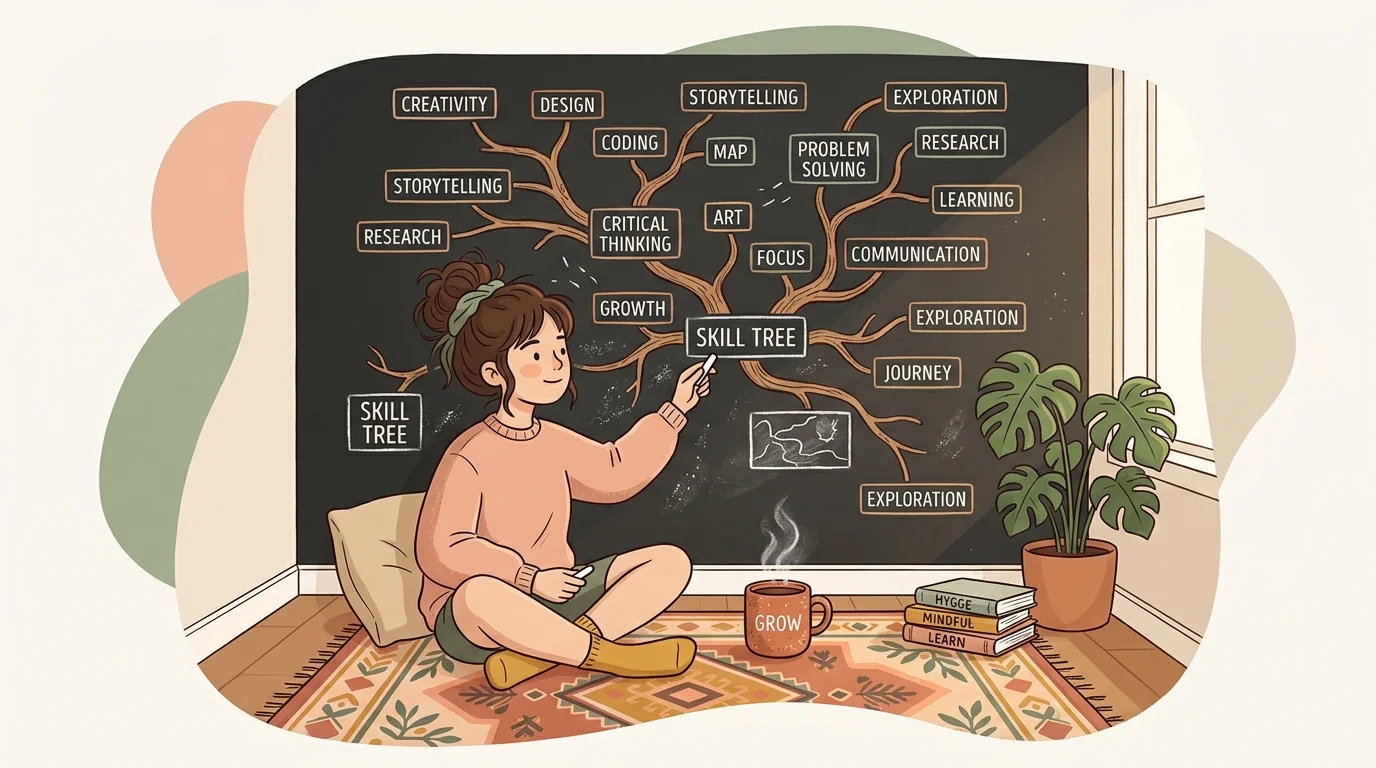
One of the primary reasons self-directed learners abandon difficult subjects is not a lack of discipline or intellectual capacity, but incorrect sequencing. Attempting to master an advanced technique before solidifying its prerequisite foundations creates cognitive friction that feels insurmountable. To navigate deep learning pathways efficiently, modern autodidacts borrow architectural concepts from software engineering by constructing skill dependency trees.
A dependency tree visually and logically organizes knowledge so that every foundational concept is mastered before dependent subskills are introduced. On EZ Upskill, we champion structured meta-learning systems that eliminate wasted study hours. Let us examine how mapping your learning process through dependency modeling eliminates hidden bottlenecks and accelerates competence.
Key Takeaways
Strategic benefits of dependency-based learning:
- Skill acquisition failure is frequently caused by tackling concepts whose prerequisites have not yet been internalized.
- Dependency trees structure learning as a directed network where upstream fundamentals enable downstream mastery.
- Identifying critical path skills prevents wasting precious study hours on tangential subskills.
- Modular practice allows learners to isolate and repair broken conceptual links without starting an entire course over.
The Logic Behind Prerequisite Mapping
In computer science and project management, complex systems are structured as directed acyclic graphs. Every task requires certain inputs before it can execute. Human cognitive architecture functions identically: your brain cannot synthesize sophisticated insights without possessing the fundamental schemas upon which those insights rely.
Consider an aspiring data strategist. If they dive straight into predictive machine learning algorithms without a grounded understanding of linear algebra and probability distributions, the math appears like arcane hieroglyphics. They struggle for weeks, conclude they are “not a math person,” and quit. In reality, their intellectual capability was never the bottleneck; their learning sequence was simply inverted.
By mapping skill dependency trees in advance, you immediately spot the missing prerequisite links. When you discover that mastering basic matrix transformations enables five different advanced algorithmic concepts, you know exactly where to allocate your immediate study energy.
Prerequisite mapping also shields you from the illusion of productivity. Many ambitious individuals spend hours gathering books, organizing notes, and watching tutorial videos without ever engaging in actual skill transmission. A dependency tree makes your learning milestones concrete, measurable, and strictly dependent on functional verification rather than passive reading.
How to Construct a Functional Dependency Map
Constructing a dependency map requires three methodical stages: reverse engineering the end goal, categorizing prerequisite tiers, and identifying the critical path.
Phase 1: Reverse Engineering the Terminal Goal
Begin at the finish line. Define the terminal capability in concrete, observable terms – for example, “delivering a persuasive twenty-minute keynote presentation to corporate executives without notes.” From that terminal node, ask: What specific subskills must exist for this performance to succeed? This directly connects with how to deconstruct complex skills into manageable components.
Phase 2: Establishing Upstream Node Relationships
For each subskill identified, trace backward again. For speech delivery, you need memorization systems, vocal resonance control, and narrative pacing. To have vocal resonance control, you need diaphragmatic breathing control and posture alignment. Continue branching backward until you reach foundational abilities you already possess.
Phase 3: Highlighting the Critical Learning Path
The critical path represents the sequence of dependent nodes that directly dictates total time to competency. Secondary branches – such as designing slide graphics or choosing background music – can be postponed or outsourced. Your core study schedule should prioritize the primary trunk of the tree.
Step-by-Step Blueprint: Mapping Technical Analysis
To see how this works in practice, examine a concrete demonstration for an individual learning financial modeling and commercial analysis. Rather than jumping between disparate textbooks and online courses, the learner establishes a four-tier hierarchical outline:
- Tier 4 (Terminal Output): Forecasting three-statement financial projections with automated sensitivity scenarios for investment evaluation.
- Tier 3 (Functional Subskills): Linking balance sheets to cash flow statements, building dynamic depreciation schedules, and structuring debt amortization tiers.
- Tier 2 (Core Mechanics): Understanding double-entry accounting mechanics, working capital cycles, and capital expenditure timing rules.
- Tier 1 (Foundational Primitives): Basic spreadsheet formula syntax, mathematical order of operations, and fundamental accounting terminology (assets, liabilities, equity).
With this map clearly visible, the learner never attempts to link three financial statements (Tier 3) until they can balance a basic ledger without hesitation (Tier 2). Every study session has an unmistakable objective, and progress is measured by moving up the tiers sequentially.
Diagnosing and Unblocking Hidden Learning Bottlenecks
When you hit an unexpected plateau during self-study, do not increase your daily practice hours blindly. Doing more of what is currently not working merely reinforces faulty procedural habits and breeds frustration.
Instead, inspect your dependency tree like an engineer diagnosing an assembly line stoppage. Trace backward from the point of failure. If you struggle with persuasive sales writing, ask whether the issue lies in your headline hook, your problem agitation, or your offer clarity. If your problem agitation is weak, trace further back: Do you actually understand the customer’s daily operational headaches?
In nine out of ten cases, the obstacle is located two nodes upstream from where the symptom surfaced. Once you repair that upstream gap through targeted drills, downstream competence flows smoothly. Coupling this diagnostic precision with mastering micro-skills practice ensures each node is thoroughly tested before advancing.
Furthermore, this diagnostic mindset eliminates feelings of inadequacy. Instead of telling yourself that you lack innate talent for a discipline, you treat your progress as an engineering puzzle. When a component fails, you simply inspect the upstream connections, patch the missing schema, and test the circuit again.
Visualizing Skill Stacks for Lifelong Career Resilience
Dependency trees are not limited to individual technical tasks; they can be scaled to map entire multi-year professional trajectories. In modern knowledge industries, the most resilient professionals are not narrow specialists, but T-shaped polymaths who combine complementary skills.
When you map your career as an interconnected forest of dependency trees, you discover powerful cross-pollination opportunities. Core principles learned while mastering public speaking – such as reading room dynamics and pacing information delivery – become immediate upstream prerequisites for executive leadership, investor relations, and podcast hosting.
This holistic overview prevents career myopia. You realize that learning a seemingly unrelated discipline like classical rhetoric or storytelling provides the foundational trunk that supports multiple high-income professional branches. You stop acquiring random credentials and start accumulating compounding mental assets.
Frequently Asked Questions
What software or tools should I use to build dependency trees?
You do not need specialized software. A standard physical notebook, a digital whiteboard like Miro or Obsidian Canvas, or simple text outlines with nested bullet points work remarkably well. The value comes from the conceptual clarity of the connections, not the visual complexity of the tool.
How detailed should a single dependency tree be?
Aim for three to four tiers of depth. Tiers that are too shallow fail to isolate the true root mechanics, while trees with ten or more tiers create unnecessary administrative overhead. Keep it practical and focused on actionable drills.
Can a skill have multiple independent starting nodes?
Yes. Many complex fields have several parallel entry points that can be studied concurrently. For example, in digital product design, you can develop typography understanding and user psychology research in parallel before merging them into interface layout practice.
When you sequence your learning with intentional architecture, every hour of effort compounds upon the last, transforming confusion into predictable mastery.